Polymer Cement in Peru: How Seismic Code E.030 and Reconstruction Spending Drive Repair Mortar Demand
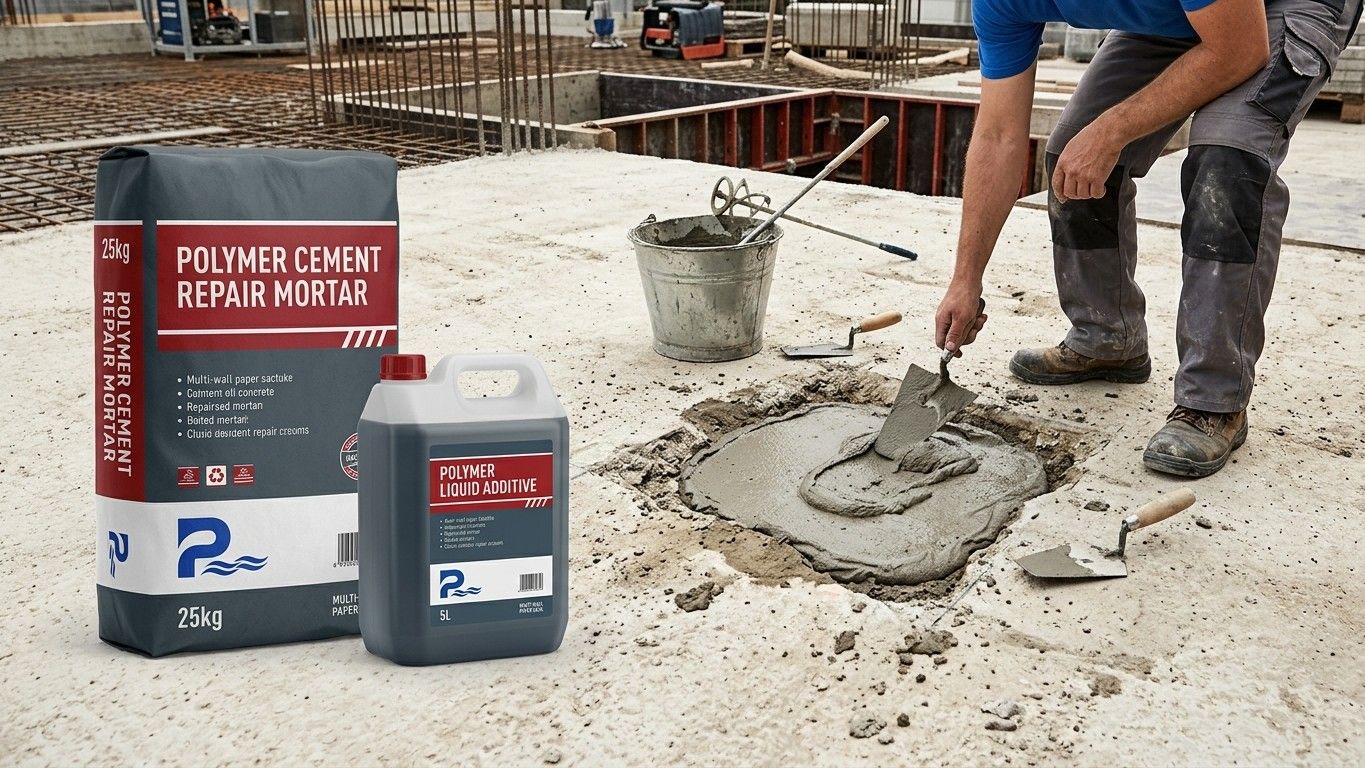
Peru's seismic code, Norma Técnica E.030, requires that any earthquake-damaged building be evaluated by a civil engineer and reinforced, repaired, or demolished, per Peru's Ministerio de Vivienda (MVCS). That mandate sits on a funded public pipeline: the post-2017 reconstruction authority spent over S/ 4,055 million, and its 2024 successor, ANIN, now administers 194 projects worth roughly S/ 48,922 million, per Peru's Congress and Gestión — a standing, regulation-driven demand channel for structural repair mortars.
What Peru's Seismic Code Actually Requires for Damaged Structures
How Peru's Seismic Code Turns Earthquake Damage Into Repair Mortar Demand
- 1
Earthquake damage occurs
A structure sustains seismic damage under Peru's National Building Code framework
- 2
Engineer evaluation required
A civil engineer must assess the structure and its geotechnical characteristics, per IISEE's summary of Peru's seismic code
- 3
Reinforce, repair, or demolish
The engineer determines the outcome; repair must restore stiffness, resistance, and ductility
- 4
Repair mortar specified and sourced
Structural repair and retrofit mortars, including polymer cement, are specified for qualifying repair work
Peru sits on the Pacific Ring of Fire, and its building code reflects that. Norma Técnica E.030, "Diseño Sismorresistente," was updated and approved by Resolución Ministerial N°355-2018-VIVIENDA, issued October 22, 2018 and published in the official gazette El Peruano the following day, per Peru's Ministerio de Vivienda, Construcción y Saneamiento (MVCS). Its stated objective is to make sure building design and construction achieve seismic performance that avoids loss of life, keeps basic services running, and limits property damage.
For a sourcing manager, the more important detail sits one layer deeper than the design code itself. Under Peru's National Building Code, once a structure has sustained earthquake damage, a civil engineer must evaluate it — including the site's geotechnical characteristics — and determine whether it needs reinforcement, repair, or demolition, per the International Institute of Seismology and Earthquake Engineering (IISEE), Building Research Institute of Japan. Repair work must restore the right combination of stiffness, resistance, and ductility so the structure performs adequately in future earthquakes.
That evaluation-and-repair obligation is the real demand driver for a product like polymer cement mortar. It is not a one-time design requirement buried in a permit file; it is a recurring obligation that activates every time a building takes seismic damage, in a country that experiences frequent earthquakes. A repair mortar with a documented bond strength advantage over standard cement mortar is a direct fit for this specific, code-mandated repair step — more relevant to this buyer than a general product pitch about construction materials.
From ARCC to ANIN: Is Peru's Reconstruction Spending Still a Live Demand Channel?
ARCC vs. ANIN: Peru's Reconstruction Authority Transition
| ARCC (2017-2023) | ANIN (2024-present) | |
|---|---|---|
| Legal basis | Created by Ley N° 30556 (2017) after the 2017 coastal El Niño | Successor entity attached to the PCM, effective January 1, 2024 |
| Budget / pipeline scale | Comprehensive plan budgeted at more than S/ 25,655 million | Administers 194 projects worth approximately S/ 48,922 million |
| Status | Legal mandate ended December 31, 2023 | Active as of this article's last_updated date |
Peru's government has also funded reconstruction and retrofit work directly. The Autoridad para la Reconstrucción con Cambios (ARCC) was created by Ley N° 30556, enacted April 25, 2017, to rebuild infrastructure damaged by the 2017 coastal El Niño floods and to carry out disaster-risk-reduction works, operating under a comprehensive plan budgeted at more than S/ 25,655 million, per ComexPerú, a Peruvian trade-policy research organization. By January 2022, the program reported 55% of its 6,075 planned interventions completed, benefiting more than 2.4 million people across nine departments, per the same source.
The natural sourcing question is whether that spending held up over time or stalled out. Peru's Congress reported that between ARCC's 2017 creation and mid-2023, the authority had spent more than S/ 4,055 million on current expenses — personnel and purchases — versus S/ 6,341 million invested directly in project execution, with total budget utilization at 57.3% of assigned funds since 2017, per the Congreso de la República's own communications office. ARCC's legal mandate then ended December 31, 2023.
Rather than the program winding down, Peru transferred it. The Autoridad Nacional de Infraestructura (ANIN), attached to the Presidencia del Consejo de Ministros, began operating January 1, 2024 to continue executing infrastructure projects inherited from ARCC, per the Peruvian business newspaper Gestión. A Supreme Decree moved 150 ARCC projects, each valued at S/ 200 million or more, to ANIN starting in November 2023, and Congress was asked to approve an S/ 854 million supplementary credit to keep those projects moving. Since January 2024, ANIN has administered 56 government-to-government contracts inherited from ARCC, covering 194 projects and interventions worth an estimated S/ 48,922 million. For a supplier evaluating this market, the institutional name changed, but the funded pipeline of reconstruction and infrastructure work continued into its successor.
Import Cost Stack: Korea-Peru FTA and Peru's 18% IGV
Confirm the Exact Duty Rate Before You Quote
Confirm the Exact Duty Rate Before You Quote
This article confirms the Korea-Peru FTA is in force and that Peru applies an 18% IGV on top of any duty, but it does not have a verified figure for the exact current tariff tier on this product's specific 10-digit HS subheading. Confirm that number directly with SUNAT's ADUANET tariff lookup tool or a licensed Peruvian customs broker before quoting a landed cost.
Landed cost is where most sourcing decisions actually get made, and Peru's cost stack has two confirmed pieces. First, the Free Trade Agreement between the Republic of Korea and the Republic of Peru was signed March 21, 2011 in Seoul and entered into force August 1, 2011, per the Asian Development Bank's Asian Regional Integration Center (ARIC) FTA database. That agreement gives Korean-origin goods, including construction materials, a legal channel to preferential tariff treatment once rules-of-origin documentation is in place.
Second, Peru applies a standard 18% Value Added Tax, known as IGV, on most imports, in addition to any applicable customs duty, calculated on the CIF value plus duty, per the U.S. International Trade Administration's Peru Country Commercial Guide. That 18% is a fixed, confirmed cost every importer should model regardless of the duty outcome.
What this article cannot confirm is the exact current duty tier for polymer cement mortar's specific 10-digit HS subheading. Research into Peru's tariff-tier structure and SUNAT's line-item classifications did not turn up a directly verifiable figure for this product, so treat any specific duty percentage you see elsewhere with caution until you confirm it directly through SUNAT's ADUANET tariff lookup tool or a licensed Peruvian customs broker, per SUNAT's own published import-classification process.
Product Standards and What Peruvian Buyers Will Ask For
What to Confirm Before Quoting a Peru Reconstruction or Retrofit Buyer
- ✓ Project funding sourceConfirm whether the buyer's project sits inside the ANIN-administered pipeline or is privately funded — documentation needs can differ
- ✓ HS classification and dutyConfirm the 10-digit national subheading and current duty tier with SUNAT or a customs broker
- ✓ FTA origin documentationAsk whether your supplier can issue a certificate of origin or qualifying declaration under the Korea-Peru FTA
- ✓ 18% IGV budgetBuild Peru's VAT into landed-cost math; it applies on top of CIF plus duty
- ✓ Applicable product standardAsk the specifying engineer which NTP or equivalent standard, if any, the project requires
- ✓ Lot-level quality certificatesRequest batch test certificates for the specific lot before it ships
Peruvian buyers and their specifying engineers will want documentation, not just a data sheet. Peru's national standards body, INACAL, maintains a defined set of Normas Técnicas Peruanas covering cement and concrete — eleven standards for cement, four for concrete, and one for aggregates and additives, based on a compiled technical reference published by a domestic cement manufacturer. That compiled list does not include a standard specific to polymer-modified or masonry repair mortars, so this article cannot point to a single mandatory NTP for this product category, and you should not assume one exists without checking with the buyer's engineer.
In the absence of a confirmed product-specific NTP, documentation shifts to manufacturer-level evidence. Per ITOS Co.,Ltd's own lot quality certificates, its polymer cement formulation is produced to KS F 4716 with an asbestos-free, low-VOC mix, and each lot ships with test figures covering 28-day compressive strength above 45MPa, flexural strength above 9MPa, and bond strength above 2.0MPa — roughly double the bond strength of a standard cement mortar on a concrete substrate. For a buyer without a matching Peruvian standard to point to, that kind of batch-level, third-party-verifiable test data is what actually satisfies a specifying engineer's due diligence.
Where the Demand Is Concentrated and How Korean Suppliers Enter
Two buyer types are worth distinguishing. The first works on or around ANIN's inherited project pipeline — contractors and material distributors supplying government-funded reconstruction and infrastructure work, where documentation, lot traceability, and consistent batch quality matter most because public contracts carry audit requirements. The second is the private and municipal repair market — engineering firms and building owners responding to the post-damage evaluation mandate on individual structures under E.030, per the National Building Code obligation described above, on structures such as bridges, parking structures, and commercial buildings, where speed of return to service often matters as much as price.
A one-pack, water-only formulation fits both buyer types for a practical reason: site crews do not need to measure and mix separate components, which keeps quality consistent whether the crew is a large contractor's team or a smaller repair outfit. Per ITOS Co.,Ltd's product specifications, a pot life of 40 minutes at 20°C, walkable surface in 6 hours, and full cure in 7 days also line up with the urgency common to both post-earthquake repair work and infrastructure projects that cannot stay closed indefinitely.
For a Korean supplier's first move into this market, the practical entry points are distributor partnerships already serving Peru's construction-chemicals sector, direct outreach to contractors working ANIN-inherited projects, and OEM or private-label conversations with buyers who need a specific formulation adjustment rather than a stock product. Per ITOS Co.,Ltd's standard order terms, a minimum order quantity around 20 tons and monthly production capacity of about 3,000 tons give a distributor room to test the relationship at a manageable volume before committing to larger repeat orders.
For how similar landed-cost mechanics play out in a neighboring market, see our Chile polymer cement import guide.
Frequently Asked Questions
Does Peru's E.030 seismic code actually require existing buildings to be retrofitted, or does it only govern new construction?
E.030 sets the seismic design standard primarily for new buildings, but Peru's National Building Code adds a separate, related obligation: once a structure has been damaged by an earthquake, a civil engineer must evaluate it, including its site's geotechnical characteristics, and determine whether it needs reinforcement, repair, or demolition, per the International Institute of Seismology and Earthquake Engineering (IISEE). Repair work has to restore the right combination of stiffness, resistance, and ductility to perform in future earthquakes. That post-damage evaluation-and-repair obligation, not new-construction design alone, is what creates recurring demand for structural repair mortars.
Now that ARCC's mandate ended in 2023 and ANIN took over Peru's reconstruction projects, is public infrastructure spending still a reliable demand channel?
Yes, based on the transition record. The Autoridad para la Reconstrucción con Cambios (ARCC) had spent more than S/ 4,055 million on current expenses and S/ 6,341 million directly on project execution by mid-2023, per Peru's Congress. When its legal mandate ended December 31, 2023, a Supreme Decree transferred 150 ARCC projects, each valued at S/ 200 million or more, to the new Autoridad Nacional de Infraestructura (ANIN), which began operating January 1, 2024, per Gestión. Since then, ANIN has administered 56 government-to-government contracts covering 194 projects worth an estimated S/ 48,922 million inherited from ARCC. The institution changed names, but the funded project pipeline continued.
What import duty applies to polymer cement repair mortar shipped from Korea into Peru, and does the Korea-Peru FTA bring it to zero?
The Free Trade Agreement between Korea and Peru has been in force since August 1, 2011, providing the legal channel for Korean-origin goods, including construction materials, to qualify for preferential tariff treatment once rules-of-origin requirements are met, per the Asian Development Bank's ARIC FTA database. On top of any applicable duty, Peru applies an 18% Value Added Tax (IGV) to most imports, calculated on the CIF value plus duty, per the U.S. International Trade Administration. The exact current duty rate for your specific 10-digit HS subheading still needs to be confirmed directly with SUNAT or a licensed Peruvian customs broker before you quote a landed cost — this article does not have a verified figure for that specific line.
Is there a specific Peruvian product standard my polymer cement needs to certify against before customs or specifying engineers will accept it?
Peru's national standards body, INACAL, maintains a defined set of Normas Técnicas Peruanas (NTP) covering cement and concrete — eleven for cement, four for concrete, and one for aggregates and additives, based on a compiled industry reference from a domestic cement manufacturer. That compiled list does not include an NTP specific to polymer-modified or masonry repair mortars, so this article cannot confirm a single mandatory standard for this product category. Before quoting, ask the buyer's specifying engineer which standard, if any, their project requires, and be ready to provide your own quality documentation, such as KS F 4716 compliance and lot-level test certificates, as supporting evidence.
If Latin America still favors steel-based seismic reinforcement over cement-based repair products, is there real near-term demand for polymer cement mortar in Peru?
Industry market research describes Latin America as having latent demand for seismic reinforcement materials but notes the region currently favors steel-based solutions, with economic volatility and uneven code enforcement as adoption barriers, per market-research publisher IndexBox. Peru's situation is more specific than that regional pattern, though: the damage-evaluation mandate under E.030 and a funded reconstruction pipeline (ARCC, then ANIN, per Peru's Congress and Gestión) create a standing legal and financial channel for repair mortar work on existing structures, narrower and more concrete than the general regional forecast. Buyers should treat this as an emerging, code-driven niche rather than an already-saturated product category.
This article is for general reference only, based on sources cited above. Regulatory requirements, tariff tiers, and applicable product standards change over time, so confirm current obligations directly with a licensed engineer, INACAL, SUNAT, or a customs broker before you finalize a shipment.
References
- El Perú Legal — Norma Técnica E.030 (Resolución Ministerial N°355-2018-VIVIENDA)
- International Institute of Seismology and Earthquake Engineering (IISEE) — Peru Seismic Code Summary
- ComexPerú — Autoridad para la Reconstrucción con Cambios
- Congreso de la República del Perú — Reconstrucción con Cambios: Gasto en Personal y Compras
- Gestión — PCM Trasladará 150 Proyectos de la ARCC a ANIN
- Asian Development Bank (ARIC) — Korea-Peru Free Trade Agreement
- US International Trade Administration — Peru Country Commercial Guide: Import Tariffs
- Cementos Inka — Normas Técnicas del Cemento y Concreto en el Perú
- IndexBox — Seismic Reinforcement Material Market Forecast
Comments
Post a Comment