Polymer Cement in Peru: How Seismic Code E.030 and Reconstruction Spending Drive Repair Mortar Demand
Polymer Cement in Peru: How Seismic Code E.030 and Reconstruction Spending Drive Repair Mortar Demand
- Get link
- X
- Other Apps
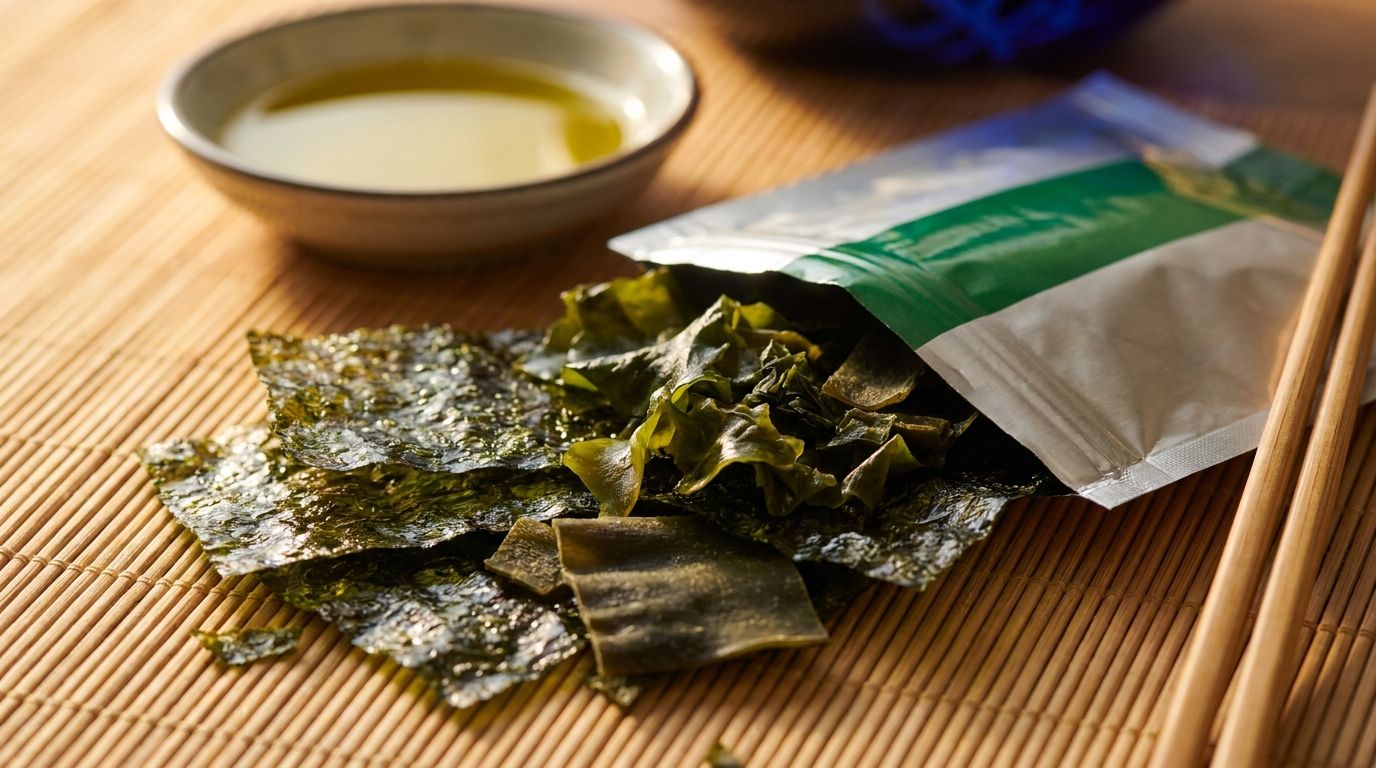
Korean crispy seaweed snacks — three-species blends of gim (laver), miyeok (sea mustard), and dashima (kelp) — are now stocked at Costco Canada, Walmart Canada, and Real Canadian Superstore, driven by a shift toward clean-label, low-calorie alternatives to conventional snack chips. North American seaweed snack sales reached approximately USD 650 million in 2024 and are growing at a projected 9.5% compound annual rate through 2033, per FoodNavigator USA citing Grand View Research. This guide covers the Canadian market demand drivers, distribution channels, and the CFIA regulatory requirements — including SFC licensing, bilingual labelling, and Canada's new 2026 front-of-package nutrition symbols — that importers need to plan for before placing their first purchase order with a Korean supplier.
For much of the past decade, roasted seaweed snacks in Canada were primarily a niche ethnic food item. That has changed. Costco Canada now carries Kirkland Signature Organic Roasted Seaweed in multipacks. Walmart Canada stocks Delicious Kitchen Roasted Seaweed Snacks. Real Canadian Superstore shelves hold Gimme Organic, Paldo, and Ocean's Halo — clear evidence that Korean seaweed snacks have crossed into mainstream retail (Costco Canada product listing; FoodNavigator USA).
According to FoodNavigator USA, adoption in Canada is growing through two buyer groups: multicultural consumers — particularly Korean and Japanese diaspora communities — who purchase as a pantry staple, and health-conscious mainstream shoppers drawn to the plant-based, low-calorie format. K-food cultural interest, amplified by global K-pop and Korean cuisine crossover, adds a third demand driver: aspirational buyers picking up Korean food products as part of a wider discovery.
Canadian Grocer reports that Canada's healthy snack category is expanding: snacking nuts, fruits, and seeds grew 15% to CAD 949 million, and puffed cakes grew 18% to CAD 102 million. The shared purchase driver across these categories — clean labels, low-calorie formats, and "permissible indulgence" positioning — maps directly onto what a Korean seaweed snack offers.
The global seaweed snacks market was valued at USD 2.43 billion in 2024 and is projected to reach USD 4.66 billion by 2030, growing at a CAGR of 11.6% from 2025 to 2030, according to Grand View Research. North America accounts for approximately 21% of that global total — around USD 650 million in 2024 — and is projected to grow at 9.5% CAGR through 2033 (FoodNavigator USA citing Grand View Research).
South Korea sits at the centre of global seaweed supply. According to the International Trade Council citing the South Korea Ministry of Oceans and Fisheries, Korea supplies approximately 70% of the world's seaweed production and reached a record USD 1.02 billion in dried seaweed exports in 2024, a 13.2% year-over-year increase. The US is the top receiving market at USD 220 million (+15.3%), with Japan at USD 210 million.
Korea's government has set a formal target to export USD 1 billion in gim by 2027 and is promoting "K-Gim" as a recognised international food brand, with a Codex Alimentarius grading standard in development (KED Global). For Canadian importers, this translates into long-term supply reliability — a well-funded government export promotion program sustains the supplier ecosystem across all volume tiers.
Canada is an emerging secondary destination in the North American corridor. Suppliers with existing US export logistics and FDA registration can serve the Canadian market with minimal additional operational setup, making the entry cost lower than a standalone market launch.
Canadian importers can access four main entry routes for Korean roasted seaweed snacks.
National mass-market chains — Costco Canada, Walmart Canada, and Real Canadian Superstore represent the highest-volume opportunity. Entry timelines typically run six to twelve months from first contact. These buyers require a Canadian importer of record, bilingual-compliant packaging, and consistent restock availability.
Ethnic and multicultural grocery chains — T&T Supermarket (30+ Canadian locations, owned by Loblaw) and H-Mart Canada are established buyers of Korean food products and are more accessible for a first Canadian market entry. They are familiar with Korean supplier documentation — HACCP certificates, FDA registration records, and certificate of origin — and require less minimum initial volume than national chains.
Online grocery and ecommerce — Amazon.ca, Well.ca, and direct-to-consumer platforms operated by ethnic food importers allow lower-friction consumer testing before committing to a major retail buyer relationship. According to FoodNavigator USA, online grocery was a key accelerant for seaweed snack adoption in North America during 2024.
Natural and health food specialty — Natural food retailers and online platforms like Well.ca carry organic-certified and clean-label snack products. A seaweed snack with verifiable HACCP certification and a clean ingredient list is a natural fit in this channel.
For a supplier with a 1,000-unit MOQ and 50,000-unit monthly capacity, a realistic first-year Canada strategy often pairs an ethnic grocery chain for market entry volume with online channel testing to establish repeat-purchase data before approaching national chain buyers.
Single-species nori (gim only) has been the most common Korean seaweed snack format in North American retail. A three-species blend — gim, miyeok, and dashima — offers a differentiated nutritional profile that supports a more compelling health claim story.
According to a 2025 peer-reviewed study published in Foods (MDPI/National Library of Medicine), iodine content in Korean edible seaweeds on a dry-weight basis is: laver/gim at 100 mg/kg, sea mustard at 177 mg/kg, and sea tangle/dashima at 2,432 mg/kg. In a blended 5g serving, the per-serving iodine contribution is modest relative to daily intake limits — but it provides a stronger nutritional hook than single-species nori.
Low-temperature olive oil roasting keeps fat absorption minimal: each 5g serving contains fewer than 25 kilocalories. Combined with a clean ingredient list — domestic Korean seaweed, olive oil, sea salt, no MSG, no preservatives — the product sits directly in the "permissible indulgence" category that drives healthy snack purchasing in Canada (Canadian Grocer). Vegan compatibility and a gluten-free manufacturing process, along with allergen-controlled production (no crustacean or nut cross-contact), reduce label complexity for importers managing multiple retailer requirements.
Iodine claim note for importers: Health Canada requires that nutrient content and health claims about iodine comply with the permitted claims list under the Food and Drug Regulations. Do not make any iodine claim on Canadian packaging without verifying compliance with Health Canada's requirements checklist and consulting a food regulatory specialist first.
Seaweed Snack vs Potato Chip: At-a-Glance Comparison
| Crispy Roasted Seaweed Snack (5g serving) | Regular Potato Chip (~28g serving) | |
|---|---|---|
| Calories | <25 kcal | ~150 kcal |
| Fat source | Olive oil, low-temperature roasted | Sunflower or palm oil, fried |
| MSG | None | Often present |
| Allergen cross-contact | No crustacean or nut cross-contact | Varies by brand |
| Key certifications | HACCP, vegan-compatible, gluten-free process | Standard food GMP |
Canada's food import framework is governed by the Safe Food for Canadians Regulations (SFCR), administered by the Canadian Food Inspection Agency (CFIA). The key requirements for Korean roasted seaweed snack importers are:
SFC Licence — All Canadian food importers must hold a valid Safe Food for Canadians Licence, applied for through the My CFIA portal. The licence is valid for two years; standard processing takes 5–10 business days, and renewal must be initiated at least 120 days before expiry (CFIA).
Import permit requirement — Processed snack foods including roasted seaweed snacks are classified as lower-risk under CFIA's Automated Import Reference System (AIRS) and do not require a separate import permit. Importers must still confirm their specific product's AIRS classification before the first shipment, as blend composition — particularly dashima content — may prompt additional iodine-related guidance (Maska Customs citing CFIA AIRS guidelines).
Bilingual labelling — All mandatory label information on consumer pre-packaged food sold in Canada must appear in both English and French: the common name, ingredient list, nutrition facts table, allergen declarations, net quantity, best-before date, and the Canadian importer's name and address (CFIA). Quebec's Bill 96, effective June 1, 2025, requires French to appear at least as prominent as any other language in size, appearance, and visual impact for products entering the Quebec market. New products must comply immediately; businesses selling in Quebec before June 1, 2025 have until June 1, 2027 to complete the transition (SourceNutra citing Quebec Bill 96 and Office québécois de la langue française).
Front-of-package nutrition symbols (effective January 1, 2026) — Under amendments to the Food and Drug Regulations, pre-packaged foods meeting thresholds for total sugars, sodium, or saturated fat must display a "high in" symbol on the front of pack from January 1, 2026. A seaweed snack with fewer than 25 kcal per serving, olive oil as the sole fat source, and no added sugars is unlikely to trigger this requirement — but importers must assess their specific formula against Health Canada's FOP assessment tool before finalizing packaging for the 2026 compliance date (NSF International).
Traceability records — Under SFCR, importers must maintain records one step forward and one step back in the supply chain for at least two years, in English or French, and available to CFIA on request (CFIA step-by-step import guide).
CFIA Import Compliance Path for Korean Seaweed Snacks
Obtain SFC Licence
Apply via the My CFIA portal. Licence valid 2 years; standard review 5–10 business days. Renew at least 120 days before expiry.
Confirm HS 121221 via AIRS
Use CFIA's Automated Import Reference System to confirm your specific seaweed blend is lower-risk and import-permit-exempt. Check composition — kelp/dashima may carry additional iodine guidance.
Prepare bilingual label
All mandatory label information in English and French: common name, ingredients, nutrition facts, allergens, net quantity, best-before date, and Canadian importer name and address. Quebec (Bill 96, June 2025): French at least as prominent as any other language.
Assess FOP nutrition symbol (Jan 2026)
Low-calorie seaweed snacks (<25 kcal/serving, no added sugars) are unlikely to trigger the 'high in' symbol. Confirm via Health Canada's FOP assessment tool before finalizing packaging.
Establish traceability records
Maintain one-step-forward, one-step-back records for at least 2 years in English or French. Available to CFIA on request under SFCR.
Canadian Bilingual Label: Mandatory Elements
Korean-origin goods entering Canada may qualify for preferential or zero-duty tariff treatment under the Canada-Korea Free Trade Agreement (CKFTA), administered by Global Affairs Canada. To claim the benefit, importers must maintain a certificate of Korean origin and confirm the product meets CKFTA rules of origin. Because this product is grown, processed, and packaged entirely in Korea, rules-of-origin compliance is generally straightforward. Consult the CBSA Tariff Finder for the specific duty rate applicable to HS 121221 and verify with a licensed Canadian customs broker before the first shipment.
CKFTA Tariff Check Before Your First Shipment
Canada-Korea FTA: Confirm the Duty Rate for HS 121221
Korean-origin roasted seaweed snacks may qualify for preferential or zero-duty entry under the Canada-Korea Free Trade Agreement (CKFTA). Maintain a certificate of Korean origin, confirm the specific duty rate for HS 121221 via the CBSA Tariff Finder, and verify rules-of-origin compliance with a licensed Canadian customs broker before your first shipment.
Last updated: 2026-06. This guide is for general informational purposes. CFIA licensing, SFCR obligations, Quebec language law requirements, Health Canada FOP rules, iodine claim regulations, and CKFTA tariff schedules change over time. Confirm all current import, labelling, and compliance requirements with the CFIA, Health Canada, CBSA, Office québécois de la langue française, qualified legal counsel, and a licensed customs broker before placing production or import orders.
The primary requirement is a Safe Food for Canadians (SFC) Licence, applied for through the My CFIA portal. The licence is valid for two years and must be renewed at least 120 days before expiry, with standard processing of 5–10 business days per CFIA. You must also have a preventive control plan in place and maintain traceability records. Processed seaweed snacks (HS 121221) are lower-risk under CFIA's AIRS and generally permit-exempt — confirm your specific product classification via AIRS before the first shipment.
Processed snack foods including roasted seaweed snacks are classified as lower-risk under CFIA's Automated Import Reference System (AIRS) and are typically import-permit-exempt. The SFC Licence, combined with a preventive control plan, traceability records, and bilingual-compliant labelling, covers the core SFCR regulatory requirements. Confirm your specific blend's AIRS classification before importing — composition factors such as high-iodine kelp content may prompt additional CFIA guidance (Maska Customs citing CFIA AIRS guidelines).
Under the Consumer Packaging and Labelling Act, all mandatory label information must appear in both English and French: the common name, ingredient list, nutrition facts table, allergen declarations, net quantity, best-before date, and the Canadian importer's name and address (CFIA). For the Quebec market, Bill 96 (effective June 1, 2025) requires French text to be at least as prominent as any other language in size, appearance, and visual impact. New products must comply immediately; businesses selling in Quebec before that date have until June 1, 2027 to transition (SourceNutra citing Office québécois de la langue française).
Dashima has a high iodine content — 2,432 mg/kg on a dry-weight basis, per a 2025 study in Foods (MDPI/National Library of Medicine). In a blended 5g snack serving, the per-serving iodine intake remains modest. However, Health Canada requires that any nutrient content or health claim about iodine comply with the permitted claims list under the Food and Drug Regulations. Do not make any iodine claim — including "source of iodine" statements — on Canadian packaging without first verifying compliance with Health Canada's requirements checklist and consulting a qualified food regulatory specialist.
Yes. Under the CKFTA, Korean-origin goods may qualify for preferential or zero-duty tariff treatment entering Canada. To claim the benefit, the importer must maintain a certificate of Korean origin and confirm the product meets CKFTA rules of origin. Because this product is grown, processed, and packaged in Korea, rules-of-origin compliance is generally straightforward. Consult the CBSA Tariff Finder for the specific duty rate applicable to HS 121221 and work with a licensed Canadian customs broker to document the CKFTA claim correctly before the first shipment (Global Affairs Canada).
This information is provided for informational and reference purposes only. Always confirm current regulatory, import licence, bilingual labelling, Health Canada claims compliance, iodine claim, CBSA tariff schedule, and all CFIA requirements with qualified legal counsel, a licensed customs broker, and the relevant regulatory authorities before placing any production or import orders.
Comments
Post a Comment