Polymer Cement in Peru: How Seismic Code E.030 and Reconstruction Spending Drive Repair Mortar Demand
Polymer Cement in Peru: How Seismic Code E.030 and Reconstruction Spending Drive Repair Mortar Demand
- Get link
- X
- Other Apps
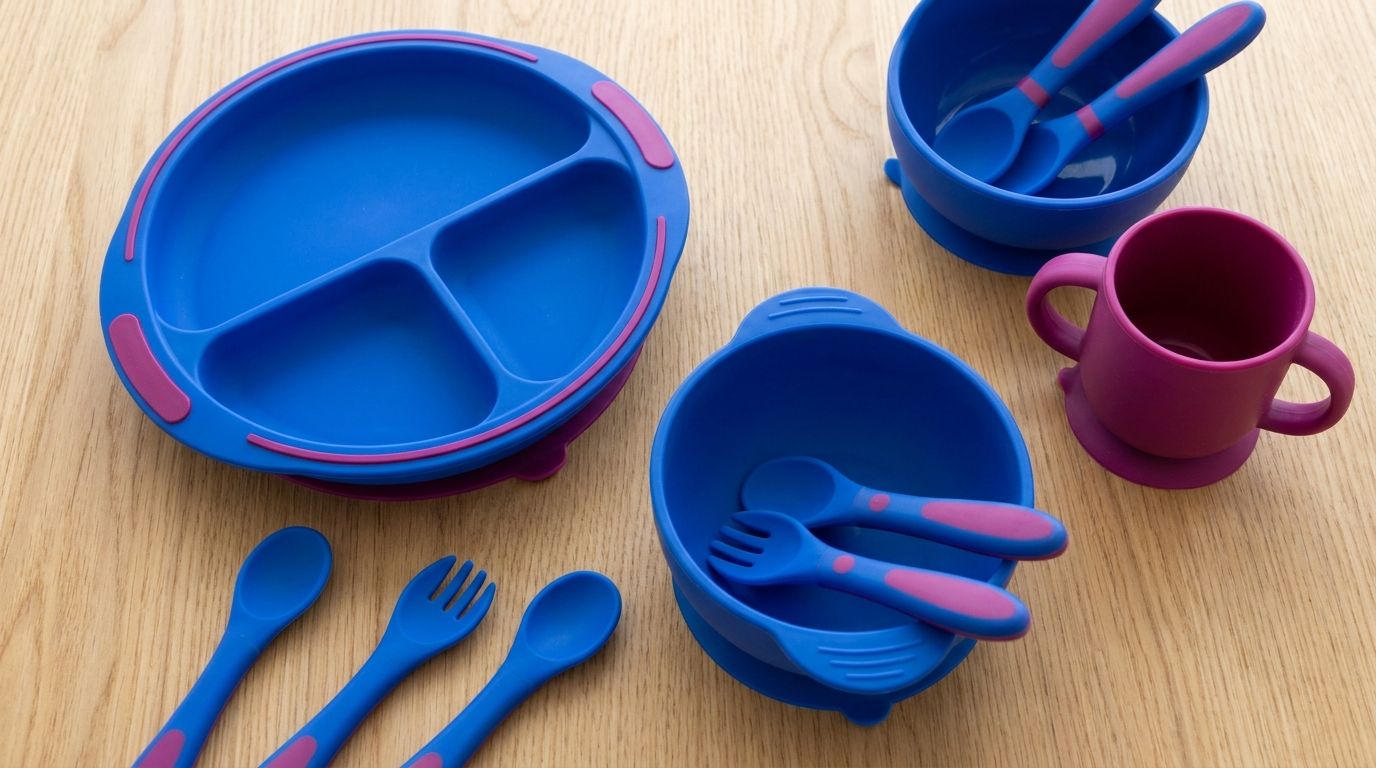
French distributors sourcing Korean silicone suction baby feeding dishes face two EU-wide deadlines that land within six weeks of each other in 2026: the REACH restriction on cyclosiloxanes D4, D5, and D6 takes effect June 6, and the EU ban on BPA in repeat-use silicone baby tableware applies July 20 — both require laboratory test data, not a marketing claim. On top of these EU deadlines, France adds a national silicone-specific law (the Arrêté du 25 novembre 1992) that neither FDA certification nor LFGB alone satisfies. This guide maps every compliance layer and shows the exact documentation path from a Korean factory to French customs clearance.
The EU has no harmonised regulation for silicone food contact materials. The base framework — Regulation (EC) No 1935/2004 — requires all food contact materials to be inert: no constituent may transfer to food at harmful levels, alter food composition, or degrade taste or odour. Per the European Commission Food Safety Directorate, a Declaration of Compliance (DoC) is mandatory at every point in the supply chain, and quality assurance systems are required under the GMP Regulation (EC) No 2023/2006. However, 1935/2004 does not set silicone-specific technical requirements.
France fills that gap with the Arrêté du 25 novembre 1992, enforced by DGCCRF (Direction générale de la concurrence, de la consommation et de la répression des fraudes). Per Légifrance, France's official legal database, this national order covers household silicone articles including baby feeding equipment, kitchen moulds, and tools. It requires:
ANSES (France's food safety agency) adds the inertia principle: silicone must not transfer any constituent to food at levels that could harm consumers or change food composition. Per ANSES, this applies regardless of existing third-country certifications.
The practical result: LFGB test reports and BfR Recommendation XV compliance are necessary but not sufficient for the French market. As Lindemann Silikon notes, importers targeting France should request test reports explicitly referencing both BfR Rec XV and the French Arrêté 1992. If your current LFGB report does not cite the Arrêté, you need a supplementary lab report or written declaration before shipping to France.
Seven regulatory layers apply simultaneously to a silicone suction baby feeding dish set exported from Korea to France.
Layer 1 — EU Regulation (EC) No 1935/2004 and GMP (EC) No 2023/2006
The foundation framework for all EU food contact materials. Per the European Commission, a DoC is mandatory throughout the supply chain. Quality assurance and quality control systems must be documented under the GMP Regulation.
Layer 2 — BfR Recommendation XV (August 2024)
Per BfR, Germany's Federal Institute for Risk Assessment, Recommendation XV sets technical requirements for food contact silicone: authorised raw materials, cross-linking systems, additives, and migration testing protocols. An August 2024 update removed the previous 0.5% extractable threshold and added a new test method for heat-sensitive articles. EU member states — including France — widely treat BfR Rec XV as the current state of the art for silicone food contact compliance.
Layer 3 — Arrêté du 25 novembre 1992 (France)
The French national silicone law described above. Legally distinct from LFGB. Test reports must explicitly cite this regulation in addition to BfR Rec XV.
Layer 4 — EN 14350:2020+A1:2023 (Child Safety)
Per SGS, CEN published this amendment in August 2023. The standard covers drinking and eating equipment for children aged 0 to 48 months. Key points for silicone suction bowls and plates:
Layer 5 — REACH D4/D5/D6 Restriction (June 2026)
Per Intertek, on May 16, 2024, the European Commission adopted a REACH restriction on three cyclosiloxanes: D4 (octamethylcyclotetrasiloxane), D5 (decamethylcyclopentasiloxane), and D6 (dodecamethylcyclohexasiloxane). These are classified as very persistent and very bioaccumulative. After June 6, 2026, D4, D5, and D6 may not be present in products on the EU market at concentrations ≥ 0.1% by weight. Korean silicone manufacturers must verify their curing and compounding process does not leave residual cyclosiloxanes above this threshold in finished baby tableware.
Layer 6 — EU Regulation 2024/3190 — BPA Ban (July 2026)
Per EUR-Lex, this regulation entered into force January 20, 2025 and prohibits BPA, BPS, BPAF, and other bisphenols in food contact materials including silicone. For repeat-use silicone baby feeding dishes, the compliance deadline is July 20, 2026. A BPA-free marketing claim is not the same as documentary proof aligned with EU 2024/3190 — a test report or supplier declaration aligned with this specific regulation is required.
Layer 7 — EU GPSR 2023/988 — Importer Obligations (December 2024)
Per EUR-Lex, the General Product Safety Regulation applies from December 13, 2024. For French importers sourcing from Korea, direct legal obligations include:
Two 2026 Deadlines for Silicone Baby Tableware
Lab Testing Required — Self-Declaration Is Not Enough
June 6, 2026: REACH restriction on D4, D5, and D6 cyclosiloxanes takes effect. Silicone products with ≥0.1% by weight of these substances cannot enter the EU market. July 20, 2026: EU Regulation 2024/3190 BPA ban applies to repeat-use silicone baby feeding dishes. Both require accredited lab test results. A migration test from a lab in Korea takes 4–8 weeks; add shipping time. If your factory has not begun this testing, contact them now.
The REACH D4/D5/D6 restriction takes effect June 6, 2026. The BPA ban deadline for repeat-use silicone baby feeding dishes under EU 2024/3190 is July 20, 2026. Both require accredited laboratory test results — self-declaration is not accepted. Migration testing at an EU-recognised lab typically takes 4 to 8 weeks. Add 2 to 4 weeks for sample shipment from Korea. Importers whose suppliers have not yet generated these test reports should initiate the process immediately.
Korean Factory to French Market: 5 Compliance Steps
Gather Factory Test Reports and Traceability
Request from your Korean supplier: BfR Rec XV test report explicitly citing the French Arrêté 1992, REACH D4/D5/D6 residual analysis, BPA/BPS-free declaration aligned with EU 2024/3190, raw material traceability records per ResAP(2004)5, and the baseline FDA 21 CFR 177.2600 test report.
Commission EN 14350:2020+A1:2023 Testing
Send product samples to a CEN-accredited laboratory — SGS, TÜV Rheinland, or Intertek. Tests cover 19 migratable elements, formaldehyde, colour fastness, and primary aromatic amines. Allow 4–8 weeks including shipping time from Korea.
Issue the EU Declaration of Compliance (DoC)
The EU importer — not the Korean manufacturer — bears primary responsibility. The DoC must cite EU Regulation (EC) No 1935/2004, list restricted substances and actual migration levels, specify food type and temperature conditions, and reference testing methods including BfR Rec XV and Arrêté 1992.
Prepare French-Language Product Labelling
Under GPSR (EU 2023/988), instructions and safety warnings must be in French. The EU importer's name, registered trade name, postal address, and email must appear on the product or packaging.
Assemble Customs Documents and Ship
For French customs under HS code 392490: commercial invoice, packing list, bill of lading, Certificate of Origin (for EU-Korea FTA tariff treatment), and the DoC. DGCCRF may request full test reports — have them ready in English with French summaries if possible.
Moving silicone suction baby feeding sets from a Korean manufacturer into France involves five ordered steps.
Step 1 — Gather factory test reports and raw material traceability. Request from your Korean supplier: a BfR Rec XV test report explicitly citing the French Arrêté 1992, a REACH D4/D5/D6 residual analysis, BPA/BPS-free documentary proof aligned with EU 2024/3190, full raw material traceability per Council of Europe ResAP(2004)5, and the baseline FDA 21 CFR 177.2600 report.
Step 2 — Commission EN 14350:2020+A1:2023 testing. Send samples to a CEN-accredited lab — SGS, TÜV Rheinland, or Intertek. Testing covers 19 migratable elements, formaldehyde release, colour fastness, and primary aromatic amines. This step is required because the product targets children aged 6 months and older.
Step 3 — Issue the EU Declaration of Compliance. Per ComplianceGate, EU importers — not Korean manufacturers — bear primary legal responsibility for issuing the DoC. Most Korean suppliers are not aware of EU DoC requirements. The document must include: issuing operator identity and address, product identity and declaration date, confirmation of compliance with EU Regulation (EC) No 1935/2004, information on restricted substances and actual migration levels tested, food type and temperature specifications, and testing methods referencing BfR Rec XV and the Arrêté 1992.
Step 4 — Prepare French-language product labelling. Under GPSR, instructions and safety warnings must be in French. The EU importer's contact details must appear on product or packaging. Verify that no unsubstantiated claims appear under French consumer law.
Step 5 — Assemble customs documents and ship. For French customs under HS code 392490: commercial invoice, packing list, bill of lading or airway bill, Certificate of Origin for EU-Korea FTA tariff treatment, and the DoC. DGCCRF market surveillance may request full test reports — have English originals and French summaries ready.
French Customs Documentation Checklist
Per ComplianceGate, six elements are mandatory in every EU FCM Declaration of Compliance:
The DoC must be available to DGCCRF market surveillance authorities and to all parties in the supply chain on request. Per the Council of Europe ResAP(2004)5, referenced by French authorities alongside the Arrêté 1992, full raw material traceability records should also be maintained by the silicone manufacturer.
Starfield Commerce produces silicone suction baby feeding dish sets in food-grade 100% silicone — BPA, BPS, PVC, and lead free — with an integrated vacuum suction pad tested to 7 kg pull force. The set is microwave and dishwasher compatible and covers ages 6 months and above. The product holds FDA 21 CFR certification as a compliance baseline. Targeted certifications for the French and EU market — including BfR Rec XV with Arrêté 1992 reference and EN 14350:2020+A1:2023 — are available for discussion with buyers. ODM orders with brand colour options are available from MOQ 1,000 units, with monthly capacity of 50,000 units.
Comments
Post a Comment